
In music production, we have thousands of plugins at our disposal. EQs, compressors, reverbs, saturators and all kinds of processors promise to improve our mixes and take our productions to the next level.
However, after so many years producing electronic music, I have learned that we do not need hundreds of tools to get good results.
What matters is knowing the ones we use, understanding what they can bring to our music and, above all, knowing when to use them.
In this article, I want to share five of my favorite effects plugins. Some have been part of my productions for many years, while others are recent discoveries, but they all have something in common: they help me get the sound I want without making my workflow unnecessarily complicated.
A personal reflection: fewer plugins, more music
Before getting into the list, I want to share something about the way I work.
I have to admit that I am not particularly keen on constantly trying new plugins.
I know that might sound strange coming from someone who produces music professionally, but I have always been quite pragmatic about this.
For me, productivity and creativity are two of the most important things when I am working on a track.
I prefer tools I know inside out, whose behavior I understand and that help me quickly achieve the result I am looking for.
When I am developing a musical idea, the last thing I want is to interrupt that creative process to spend half an hour exploring a plugin I have just installed.
And I think this is especially important today.
Almost every week, new plugins, new versions and new tools appear, promising to revolutionize the way we produce music.
It is very easy to end up spending more time searching for tools than actually using them.
Personally, I prefer working with a relatively small selection of plugins I know well. This lets me make faster decisions, stay focused and put more energy into what really matters: the music.
But I also believe we need to find a balance.
Sometimes we feel that something is missing from our productions. It might be a particular texture, a different approach to processing transients or a reverb that creates an atmosphere we cannot achieve with our usual tools.
At those times, exploring other options can be very positive.
Discovering a plugin that genuinely brings something different to our sound can open up creative possibilities and help us keep evolving as producers and artists.
The key, in my view, is not to confuse having more tools with making better music.
With that philosophy in mind, here are five of my favorite effects plugins.
1. ArtsAcoustic Reverb: a classic reverb with a special sound
ArtsAcoustic Reverb is one of those plugins that has been with me for many years.
It is quite an old reverb and, as far as I know, it has not received any major updates for some time. However, it remains one of my favorites for a very simple reason: I love how it sounds.
There is something about the ambience it creates that feels particularly musical to me. It has a distinctive character that works very well with synthesizers, melodies and atmospheric elements.
In genres such as Trance or Progressive, where reverbs play a fundamental role in creating depth and emotion, finding a tool that delivers the right atmosphere can make a big difference.
Personally, I particularly like it when I want a sense of space around a melody without completely losing its definition.
A good reverb is not just about adding a long tail to a sound. We also need to control how that reverberation blends with the original instrument and the other elements in the mix.
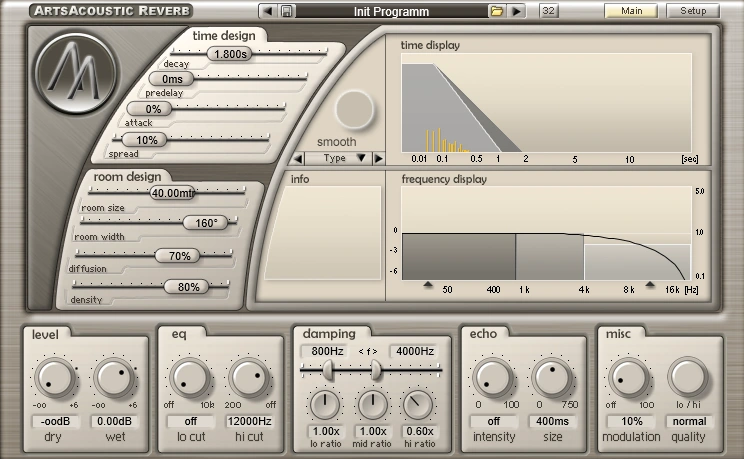
ArtsAcoustic Reverb offers controls for adjusting reverb time, predelay and various characteristics of the effect, but its feature list is not what keeps me using it.
It is the sound.
And this plugin perfectly represents my approach to working.
When a tool has been giving me exactly what I need for years, I see no reason to replace it simply because a more modern alternative exists.
Sometimes older plugins are still extraordinarily useful.
2. KNOCK: punch and presence for your drums
KNOCK, developed by DECAP, is one of the plugins I have been using most lately.
I particularly like it for percussion when I need more punch, presence and character.
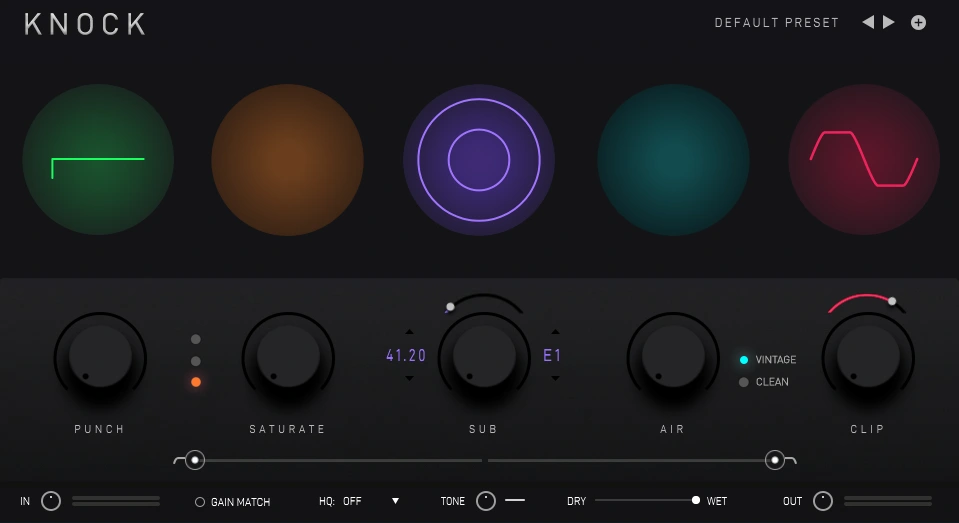
Its main advantage is that it brings together different processes designed to shape drums, including saturation, transient shaping and low-end processing.
Instead of using several different plugins to achieve a particular result, we can work with a fairly simple interface and quickly make some interesting changes.
For example, imagine we have a percussion sound that works well rhythmically but needs a little more presence in the mix.
Sometimes simply turning it up is not the best solution, because we can end up upsetting the balance with the other instruments.
With a tool like KNOCK, we can change its character, shape its transients and help it stand out in a different way.
It can also be useful on entire percussion buses when we want to give the group some cohesion and energy.
That said, we need to be careful about how much processing we apply.
Too much saturation or attack can make our drums overly aggressive, especially in a production where many elements are already competing in the mids and highs.
What I value most about KNOCK is precisely how quick it is.
It lets me experiment and get interesting results without interrupting my creative process too much.
Simple, versatile and a lot of fun to use.
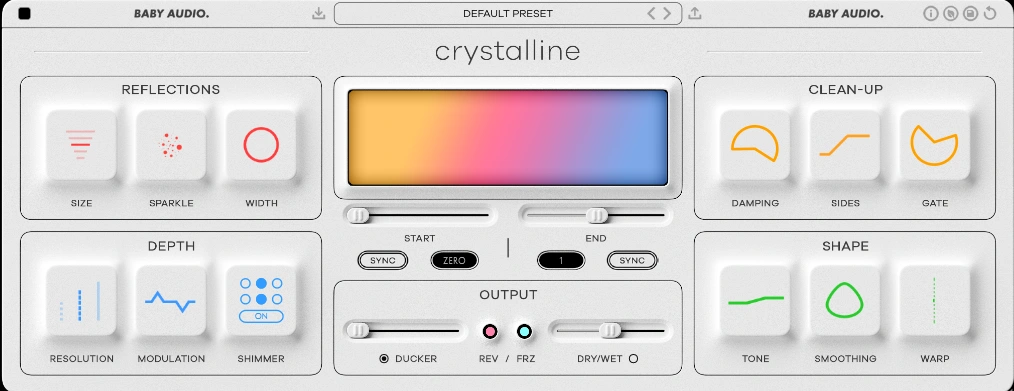
3. Baby Audio Crystalline: an impressive reverb for very little money
Crystalline, from Baby Audio, is one of my most recent purchases.
I had heard about this plugin some time ago but had never had the chance to explore it properly.
Recently, I found it on sale for just 5 euros and decided to buy it. And I have to say that, at that price, it feels like a real bargain.
Crystalline is a modern algorithmic reverb that can create everything from relatively subtle ambience to large, immersive spaces.
One interesting feature is its tempo-synced controls, which are particularly useful when producing electronic music.
It also includes various options for changing the reverb's character and adapting its behavior to the original sound.
But what I have liked most is how easy it is to use.
It has a very comfortable interface and a fairly comprehensive preset collection that lets you quickly find different spaces without always starting from scratch.
This is something I particularly value.
When I am working on a melody and need a reverb that fits the idea, I prefer having good starting points that let me focus on the musical result.
Presets can be very useful in this respect. We do not have to use them exactly as they come, but they can help us quickly find an interesting direction.
I also like how Crystalline lets you experiment with larger, more creative reverbs, particularly on pads, melodies and atmospheric elements.
It is a tool I am still discovering, but it has already earned a place among my favorites.
And although its regular price is higher, if you find it for 5 euros again, it is well worth considering.
4. Native Instruments Transient Master: three controls that can change a sound
Transient Master is one of those plugins that proves a tool does not need dozens of parameters to be useful.
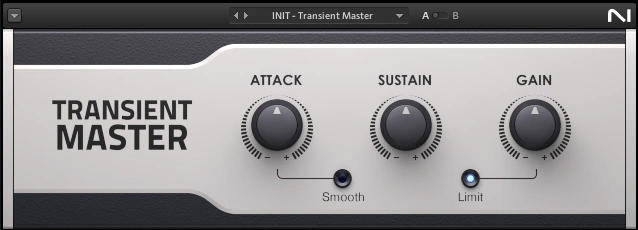
Developed by Native Instruments, it lets you change an audio signal's transient response using three main controls: Attack, Sustain and Gain.
Attack lets us increase or reduce a sound's initial punch.
Sustain changes the part after the transient, helping us control how much body or length we perceive after the attack.
And Gain adjusts the output level.
I particularly use it when I want a little more punch in kicks, percussion or even certain arpeggios.
For example, imagine an arpeggio that fits our melody perfectly but whose attacks need to stand out a little more.
We could turn to various compression or processing techniques, but sometimes a small attack adjustment with a transient processor is enough.
We can also do the opposite.
If a percussion sound has too much attack, we can soften it without completely changing its sound.
Sustain is also useful when we want to shorten certain elements or change their sense of body.
And we are not limited to using it on individual sounds.
It can work on groups of instruments, although we need to listen carefully to how it affects their overall balance and dynamics.
What I like most about Transient Master is how intuitive it is.
You identify what the sound needs, adjust one or two controls and check the result.
You do not need to spend too long configuring complex parameters.
That simplicity is precisely one of the reasons it remains one of my favorite tools.
5. Black Box Analog Design HG-2: saturation, warmth and body
To round off this selection, I want to talk about one of my favorite plugins for adding warmth and character to particular sounds.
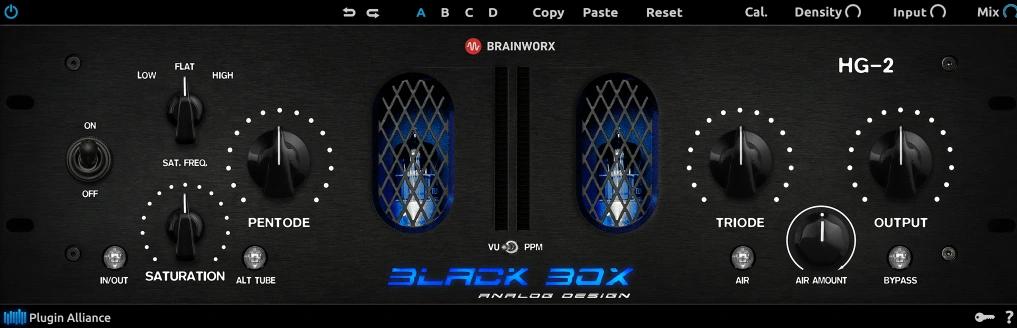
Black Box Analog Design HG-2, available as a plugin from Plugin Alliance, is a saturation processor inspired by analog tube hardware.
Its purpose is to add harmonic coloration, density and a sense of warmth that can be particularly useful in music production.
Personally, I really like using it on basses.
When a bass needs a little more body, or I want to make it more present in the mix, HG-2 can add a very pleasing texture.
In electronic production, particularly when working with different bass layers, we do not always need to turn up the low frequencies to create a greater sense of body.
Sometimes adding harmonic content through saturation can help us hear the instrument more clearly and give it more character.
HG-2 lets you combine different saturation stages to achieve different kinds of coloration, from relatively subtle settings to more intense sounds.
It is not simply a tool for adding distortion.
Used well, it can enrich an instrument's harmonic content and change the way we perceive its body.
And here I return to one of my usual principles when working with effects: listening is more important than looking at the parameters.
We do not need to apply a lot of saturation to get an interesting result.
Sometimes a small adjustment is enough to give a bass the warmth and presence we were looking for.
It is also important to compare the processed sound with the original at a similar volume. Otherwise, we may think the result is better simply because it is louder.
It is one of those plugins I like to use mainly by ear, finding the point where the sound improves without losing its original character.
Conclusion: know your tools before buying more
These are five of my current favorite effects plugins.
Some, like ArtsAcoustic Reverb, have been part of my sound for many years. Others, like Crystalline or KNOCK, are more recent additions that I am particularly enjoying.
Each serves a different purpose: creating depth, improving transients, adding punch or providing saturation and character.
But if I had to leave you with one recommendation, it would be this: you do not need every plugin on the market to produce professional music.
We live in an extraordinary time for music production. We have access to tools that would once have been unthinkable, giving us enormous creative possibilities.
However, we also need to learn to select the ones that genuinely contribute to our work.
Personally, I would rather spend my time producing music than collecting plugins.
That does not mean we should stop experimenting. Discovering new tools can be an excellent way to find inspiration and develop our sound.
But I believe we should do it with a purpose.
It is not about having more plugins. It is about finding the tools that let us make better music in a more creative and efficient way.
Ultimately, plugins are tools. What really makes the difference is the decisions we make as producers.