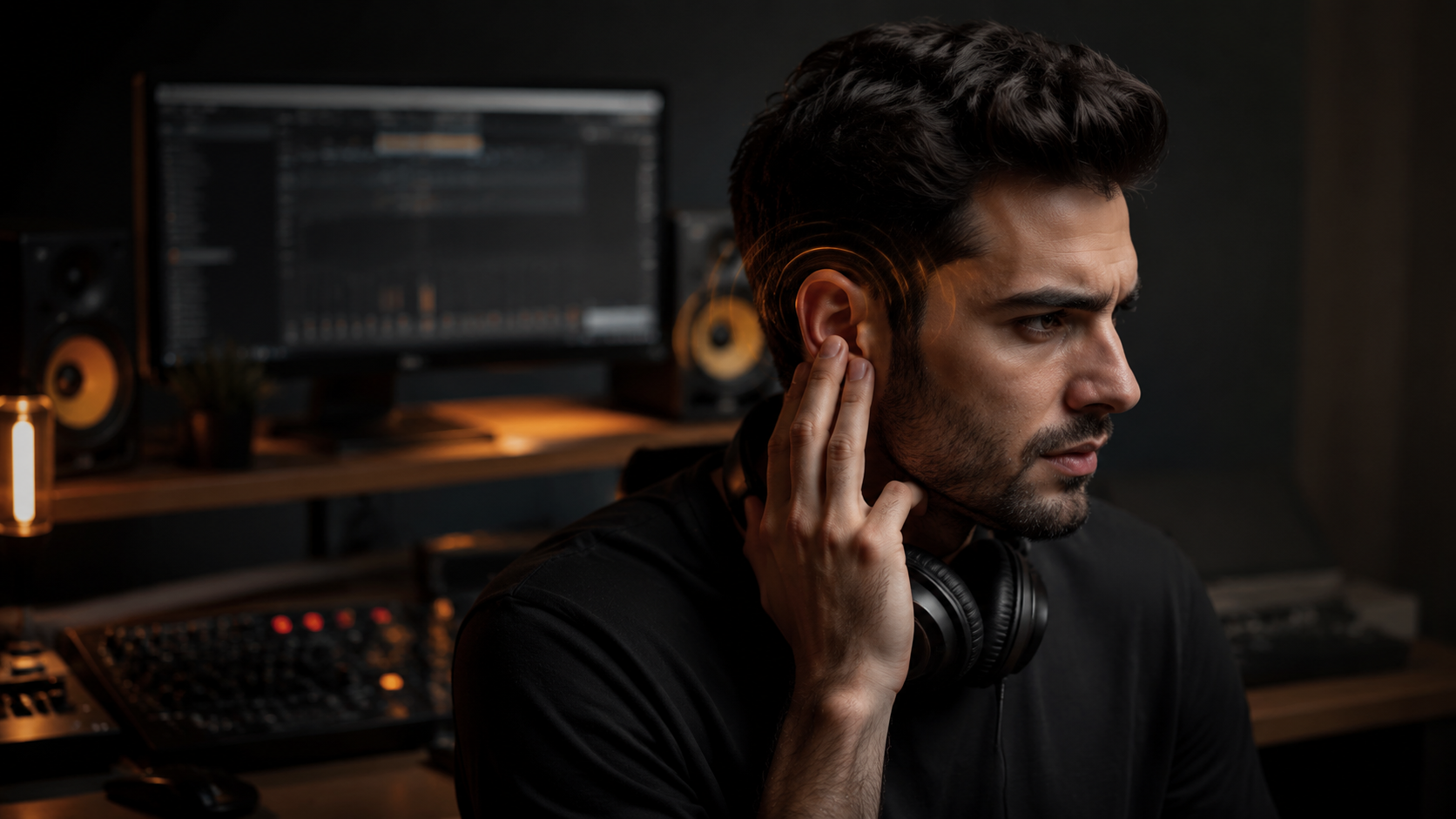
Between the ages of 14 and 16, I used to listen to music very loudly on headphones. I had already started producing and I did not think too much about volume. One day, when I was 17 or 18, I heard a very faint ringing at home. I walked through the rooms trying to find where it was coming from until I realised it was coming from my own ears.
I was really scared. I searched for information online and found stories from people whose tinnitus seriously affected their sleep and daily life. Not every experience is like that: some people perceive a mild sound that barely bothers them, some only notice it in silence and some do not perceive it at all. But I had just discovered it, and those stories pulled me down. For a while, I wanted nothing to do with music or production. I even thought about getting rid of my computer, headphones and records.
Little by little, I got my life back and stopped constantly checking whether the ringing was still there. At some point, I barely noticed it anymore, except in very quiet places, like when going to bed. I also started taking volume more seriously and using custom hearing protection in clubs and events.
I do not know the specific cause of my tinnitus. Loud music may have played a role, but my father, my mother and my brother also perceive it, and they do not work in music. Also, the hearing tests I have done so far have not detected hearing loss. That does not allow me to make a diagnosis, but it does remind me that tinnitus can have different factors behind it.
Recently, I went through a second crisis. I listened too loudly to a track I was producing for around 30 or 40 minutes and ended up with fatigued ears. I stopped listening to music, but the next day they still felt a little strange. I started to worry and paid so much attention to the ringing that I could even perceive it while talking to someone. That stage lasted around a month.
Today I am back to producing, listening to music and living normally. Most of the time I am not even aware of the tinnitus; if I am paying attention to a conversation or another activity, it stops occupying my attention. This experience taught me to take care of my sound exposure, but also to recognise how much fear can influence the way I experience it.
I am sharing my story because reading something like this would have helped me when I was younger. We can control volume, take breaks and protect ourselves in clubs and festivals. And if a change appears that worries us, the sensible thing is to speak to a professional instead of being alone with the worst stories we find online.
1. Our Ears Are Part of Our Profession
As music producers, we spend years training our ears. Some of that training is conscious. We compare reference tracks, search for problematic frequencies, adjust compressors and listen for tiny differences in level, width and dynamics. But a large part of it also happens without us realising it.
Every time we listen to music, part of our brain is analysing what we hear. We notice how the kick sits against the bass, how bright the lead sounds, how wide the mix feels or why one track appears more powerful than another. After years of producing, it becomes difficult to listen without paying attention to these details.
That experience develops gradually and becomes one of our most valuable professional skills. Plugins, computers and studio equipment can be replaced. The hearing ability we have trained throughout our career cannot.
This is why hearing protection should not be treated as something separate from music production. Looking after our ears is part of looking after the skill that allows us to produce in the first place.
2. Headphones Can Make It Easy to Lose Perspective
Headphones are an essential production tool. They allow us to hear small details, work at night and make decisions without the influence of an untreated room. But they also place sound extremely close to our ears, and it can be difficult to know exactly how much sound pressure we are receiving.
During a long session, our perception gradually adapts. A level that felt loud at the beginning can start to feel normal, so we turn it up slightly. After another hour, we may turn it up again.
This is particularly easy during the most exciting parts of a track. Louder music feels more powerful, so increasing the volume can make the drop feel bigger, the kick stronger and the low end more impressive. The production appears to improve immediately, even though nothing in the mix has changed.
That feeling can be useful for a brief check, but it should not become our normal working level. If we need constant high volume to feel the energy of a track, the problem may be in the production rather than the monitoring level.
3. Safe Listening Is About Volume and Time
There is not one headphone volume percentage that is safe for every producer. Different headphones, audio interfaces and amplifiers can produce very different sound levels, even when their volume controls appear to be in the same position.
What matters is the combination of level and exposure time. The World Health Organization gives a useful example: listening at an average level of 80 dB may be considered safe for up to 40 hours per week. At 90 dB, the recommended listening time falls to around four hours per week.
That is only a difference of 10 dB, but it results in a dramatically shorter safe listening time. A level that seems manageable for a few minutes may not be suitable for a long production session.
The practical lesson is simple. Keep your normal working level comfortable, use louder playback only for short checks and reduce the volume again afterwards. If you keep increasing the level as the session continues, it is probably time to take a break.
4. Working Too Loud Can Also Hurt Your Mix
High monitoring levels do not only increase hearing exposure. They can also affect the decisions we make.
When we listen loudly, the bass and high frequencies can feel more impressive. The track may appear fuller, brighter and more powerful than it really is. This can hide problems in the balance and encourage us to make decisions based on physical impact rather than clarity.
Turning the volume down is one of the simplest ways to test a mix. At a quiet level, can you still understand the main melody? Does the kick remain present? Is the vocal or lead clearly in front? Are the hi-hats suddenly dominating everything?
Quiet monitoring makes the hierarchy of the mix more obvious. The most important elements should remain understandable without needing the track to hit you physically.
This does not mean you should never listen loudly. A short loud check can help you judge impact, low-end movement and how the track might feel in a club. The important word is short.
5. Your Ears Need Real Breaks
Ear fatigue normally develops gradually. You may notice that you keep adding more high end, making the lead louder or pushing the kick harder because everything starts to feel less exciting. The following morning, the same mix can sound harsh, bright and unbalanced.
Regular breaks help prevent this loss of perspective. Leave the room, walk around or spend a few minutes without actively listening to music. Give your ears and attention a chance to reset before making another important decision.
A break is not wasted production time. Continuing to mix with tired ears often creates problems that you will need to fix later.
This is especially important when using headphones because removing them creates an immediate and complete break from the sound. With monitors, it is easy to leave the track playing in the background and convince yourself that you are resting while still analysing it.
Sometimes the best mixing decision you can make is to stop listening for a while.
6. Sound Exposure Does Not Only Happen in the Studio
For producers and DJs, sound exposure can come from many different parts of the week. We produce with headphones, mix on monitors, listen to references, check masters in the car, attend concerts and spend hours close to club or festival sound systems.
All of that exposure adds up.
When playing or attending loud events, properly fitted hearing protection designed for music is a sensible investment. Musician earplugs are made to reduce the overall level while preserving more clarity across the frequency spectrum than basic protection.
They can feel strange at first. The high frequencies may seem different, the room may feel less exciting and DJ monitoring can require some adjustment. But this is something that becomes more natural with experience.
Hearing protection should not only appear after a problem. It should be a normal part of working around powerful sound systems.
The Most Important Thing
Music producers spend years developing their ability to hear details that most people never consciously notice. We learn to recognise frequencies, dynamics, distortion, depth and tiny changes in level. That training becomes part of who we are and how we work.
We should protect it accordingly.
You do not need to stop using headphones or become afraid of loud music. You simply need to understand that sound exposure accumulates and that your normal production level should be sustainable.
Keep your monitoring level comfortable. Use loud checks briefly. Take proper breaks. Protect your ears at clubs and festivals. And if something changes, do not ignore it.
Your hearing is not only part of your studio. It is part of your health and your future in music.