You start a song and everything seems to work. You have a good idea, a melody you like or a drop that feels promising. You work on it for a few hours, maybe for several days, but eventually something stops working.
You change the kick. Tweak the bass. Add another layer. EQ the lead. Change the kick again. You open the project the next day and you are no longer sure about anything. And then the thing that has happened to almost every producer finally happens: the project ends up abandoned in a folder.
After many years producing music, I have learned that when a track does not move forward, the problem often is not our ability to produce. Many times, there is simply a decision we made at the beginning, or during the process, that is making everything much harder than it needs to be.
These are 7 reasons why you may not be finishing your songs.
1. Poor sound selection
This is one of the easiest things to overlook. You can have an incredible melody, strong chords and an idea with a lot of potential, but if the kick, clap, bass or main sounds do not work together, you will spend the rest of the production trying to fix a problem that existed from the beginning.
A good production starts with good sound selection. A good kick is not necessarily the kick that sounds the biggest when you hear it alone. It is the one that works with your bass and with the rest of the production. The same applies to a clap, a lead or a synth. When the sounds are well chosen, it is often surprising how little processing you need to make everything fit. When they are badly chosen, you can spend hours EQing and compressing without getting the result you want.
Before processing a sound until it becomes unrecognisable, ask yourself something much simpler: is this really the right sound for this song? Sometimes changing a sample takes thirty seconds and solves a problem you had been trying to fix for two hours.
2. You do not know exactly where you want to take the track
This is another situation I have found myself in many times. You start a project without being clear about what you want to achieve. What kind of energy do you want? What type of groove are you looking for? Do you want something more melodic, darker, more aggressive?
When you do not have a clear direction, you start going in circles. You try one melody. Then another. You change the bass. Try another lead. Modify the drop. Go back to the first version. And every decision opens another five thousand possibilities.
When you have a very clear idea in your head, producing becomes much more about executing that idea. This does not mean you need to know exactly what the song will be before opening the DAW. Experimentation is part of music production.
But having a direction helps a lot. A reference can help you. A track with a groove, structure or energy close to what you want can act like a compass when you start getting lost inside the project.
3. Your production is too empty
Sometimes the main elements are right, but the track still feels like something is missing.
And our first reaction is usually to add another important element. Another synth. Another bass layer. Another lead.
But maybe you do not need any of that. Very often, what is missing is simply background.
The small elements behind the production can completely change how we perceive the main elements. Imagine a kick and bass playing completely on their own. They may work technically and still feel too dry or empty.
Now add a very light texture behind them, an atmosphere or even a reverb tail coming from a vocal and controlled with sidechain. Suddenly, the kick and bass feel like they are part of something much bigger.
You may not consciously hear that background, but you immediately notice when it disappears.
Ambiences, reverbs, delays, foleys, effects, small rhythmic details and textures can add depth, movement and cohesion without competing with the main elements.
That is the key: supporting the production.
4. Maybe that melody simply does not work in that track
This can be one of the hardest decisions to make. You have created a melody you really like. So you decide that it has to work.
You start building a production around it. You change the chords, modify the bass, try different sounds, change the groove... And after hours of work, something still does not fit.
Maybe the problem is not the production. Maybe the problem is the melody itself.
And that does not necessarily mean it is a bad melody. It may be a fantastic melody that simply needs another tempo, another progression, another groove or even a completely different song.
One of the biggest mistakes we can make as producers is falling so in love with an idea that we lose the ability to question it.
If you have spent hours trying to make the whole production work around one single element, try something: remove it temporarily. Listen to the track without it. Sometimes you will immediately discover where the problem was.
And that melody can always be saved for another project.
5. You are overproducing
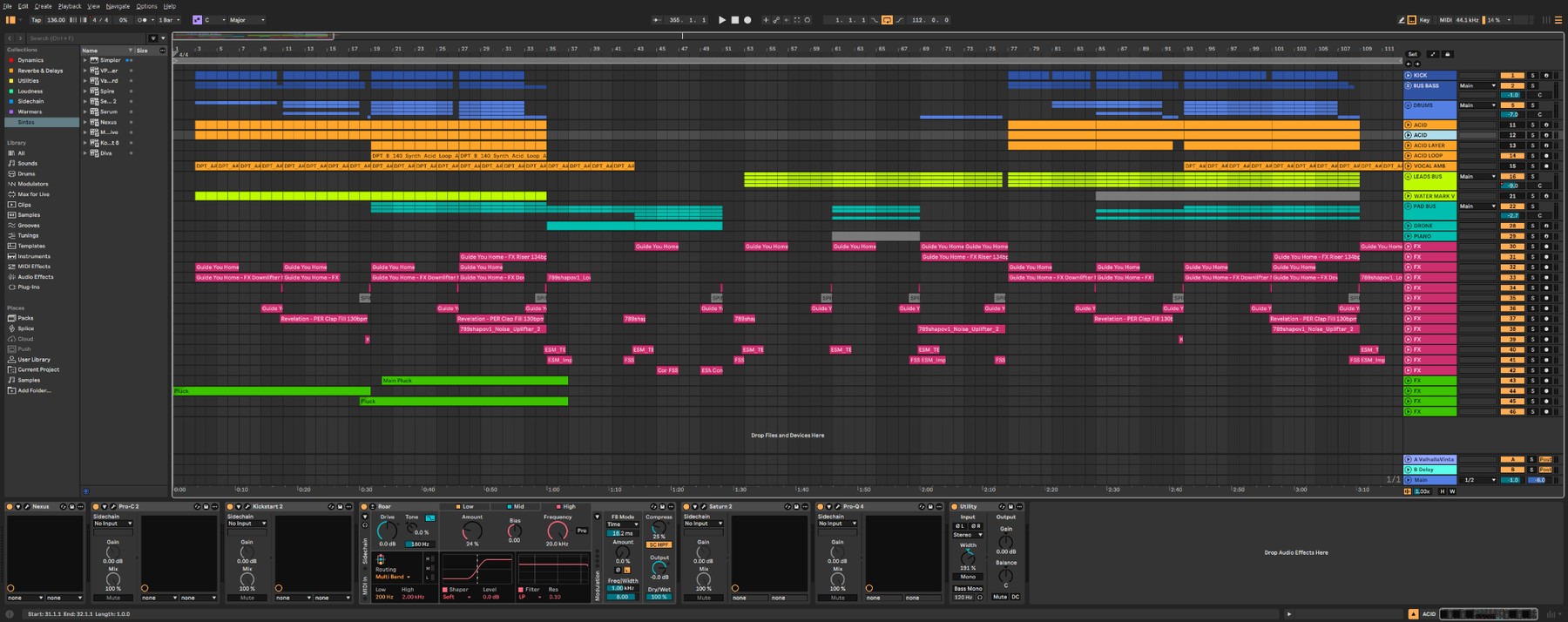
When a production does not sound professional yet, our natural reaction is usually to add things. Another layer for the lead. Another layer for the bass. Another clap. More percussion. Another texture. Another synth.
The project keeps getting more channels, but strangely it does not sound better. In some cases, it even starts sounding worse.
This happens because we are trying to solve with layers a problem that is probably somewhere else.
If you need five sounds to make a lead work, it is worth asking whether you really need five layers or whether you simply need to find a better main sound.
Every new element takes space in frequency, stereo and dynamics. The more elements you introduce, the harder it becomes to give each one its own space.
A professional production is not necessarily a complex production. In fact, very often the opposite is true: a few very well chosen elements can sound much bigger than twenty elements fighting each other.
Before adding a new layer, ask yourself:
What does this element actually add?
If you do not have a clear answer, you probably do not need it.
6. You are overmixing
This point is closely related to the previous one, but it happens in another part of the process. Today we have access to samples, synths and libraries that already sound incredibly good. Still, we often feel like we have to process everything.
We add an EQ. Then compression. Saturation. Another EQ. Maybe a multiband. We go back to the first EQ. Change the compression again...
And after twenty minutes processing a sound, we bypass the whole chain and realise it almost sounded better before.
Not everything needs processing.
In many cases, a sound only needs us to remove frequencies we clearly do not need, control a specific problem or make a small adjustment so it fits better in the mix.
If a synth already has the character and balance you are looking for, there is no obligation to put five plugins after it.
Every process should answer one question:
What problem am I trying to solve?
If you cannot answer that, you are probably processing out of habit rather than because it is truly necessary.
7. You have lost perspective
After hearing the same loop a hundred times, something inevitable happens: your brain adapts. You stop hearing the song the way another person would hear it.
And this is where some of the most dangerous production loops begin. You change the kick. Ten minutes later, you go back to the previous one. You turn the lead up. Then you turn it down. You change the bass. The next day, you bring back the older version.
At that point, maybe the problem is no longer the song. The problem is that you have been listening to it for too long.
One of the most important tools we have as producers is not a plugin: it is resting our ears.
Close the project. Do something else. Listen a few hours later or, even better, the next day.
It can also be very useful to listen outside the studio: on different headphones, in the car or simply while doing something else.
That first listen after a break is incredibly valuable. Very often, you will detect in ten seconds something you had spent two hours trying to understand.
Finishing music is also a skill
Learning music production is not only about learning EQ, compression, synthesis or mastering. We also need to learn how to make decisions.
Choosing a sound and moving forward. Accepting that a melody does not work. Removing a layer. Leaving a sound almost unprocessed. And perhaps the hardest thing of all: deciding that a song is finished.
Because we can always change something. We can always try another kick, modify an automation or adjust an EQ by 0.5 dB. But there comes a point when those changes stop improving the song and simply make it different.
If you have a folder full of unfinished projects, it does not necessarily mean you lack talent or technical knowledge.
Open one of them and analyse what is happening.
Do the sounds really work together?
Do you know where you want to take the song?
Is it missing depth or background?
Are you trying to save an idea that simply does not fit?
Have you added too many things?
Are you processing too much?
Or have you simply listened to it for so long that you have completely lost perspective?
Finding the answer may be exactly what you need to start moving forward again.
I can help you take your unfinished project to the finish line.
Finish Your Track